
This article contains affiliate links. We may earn a commission when you buy through our links, at no extra cost to you.
Your glasses prescription looks like a secret code: a grid of abbreviations, plus and minus signs, and decimal numbers. Good news — it only takes about five minutes to crack it, and once you can read it, ordering glasses online gets dramatically less scary.
One important note before we start: this guide explains the format of prescriptions. It is not medical advice, and it can’t tell you anything about your specific eyes. Questions about your prescription itself belong with your eye doctor.
The Cast of Characters: OD, OS, OU
Before the numbers, meet the Latin. Your prescription describes your two eyes separately, and it uses shorthand for each:
- OD (oculus dexter) = your right eye
- OS (oculus sinister) = your left eye
- OU (oculus uterque) = both eyes (rare on modern prescriptions)
That’s the whole trick. OD = right, OS = left. Everything else on the card is a number attached to one of these rows.
The Four Core Numbers: SPH, CYL, AXIS, ADD
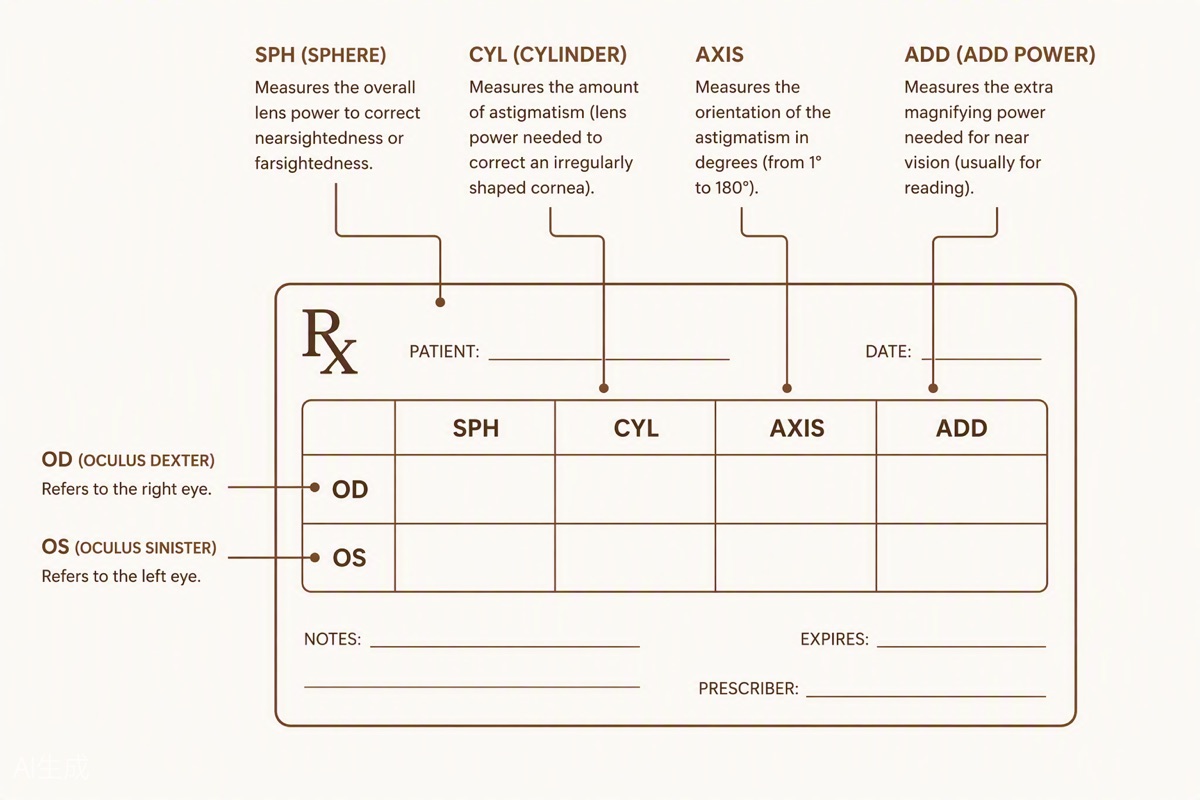
SPH (Sphere) — the main correction
This is the headline number: how much correction your eye needs, measured in diopters.
- A minus (−) number means nearsightedness (myopia) — you see nearby things clearly, distance is blurry.
- A plus (+) number means farsightedness (hyperopia) — distance is easier, close-up is the struggle.
- The further from zero, the stronger the correction. −1.00 is mild; −4.00 is moderate; −7.00+ is strong.
CYL (Cylinder) — the astigmatism correction
Astigmatism means your eye’s front surface is shaped slightly more like a football than a basketball, and CYL is the extra correction for it. Like SPH, it comes with a + or − sign and a strength. If this box is empty on your prescription, you have no (or negligible) astigmatism — lucky you, ordering is simpler.
AXIS — the angle of that correction
CYL never travels alone. AXIS is a number from 1 to 180 that tells the lab at what angle to place the cylinder correction. Think of CYL as “how much” and AXIS as “which direction.” AXIS only matters when CYL is present, and getting it right matters a lot for crisp vision — so copy it carefully.
ADD — the reading boost (if you’re over ~40)
ADD is additional magnifying power for reading and close work, and it appears mainly on prescriptions for people over 40. You’ll usually see the same value for both eyes, like +1.50 or +2.00. If you have an ADD, you’re in bifocal or progressive territory — and if you don’t see it, you don’t need it.
PD: The Number That’s Often Missing
PD (pupillary distance) is the distance between your pupils in millimeters. It’s not technically part of the prescription itself, but every online retailer needs it to center your lenses. Most adults fall somewhere in the 54–74mm range.
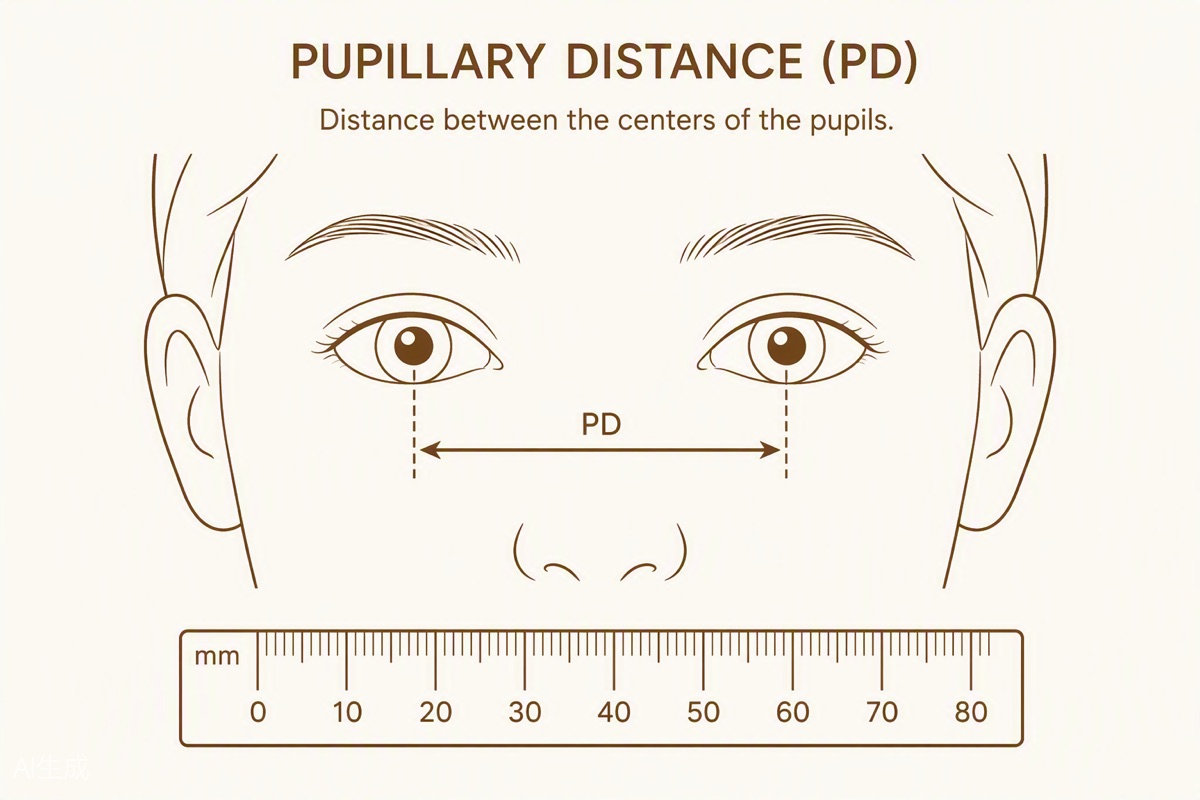
Here’s the catch: many doctors don’t write PD on the prescription. If yours is missing, call the doctor’s office — they usually have it on file — or check our guide on measuring it at home (coming soon).
A Sample Prescription, Decoded
Let’s read a completely fictional example together:
| SPH | CYL | AXIS | ADD | |
|---|---|---|---|---|
| OD (right) | −2.00 | −0.75 | 090 | +1.50 |
| OS (left) | −1.50 | −0.50 | 085 | +1.50 |
Reading it out loud: “The right eye is mildly nearsighted (−2.00) with mild astigmatism (−0.75) at a 90-degree angle. The left eye is slightly less nearsighted (−1.50) with slightly less astigmatism (−0.50) at 85 degrees. Both eyes get a +1.50 reading boost.”
That’s the whole skill. Find your numbers, map them to this grid, and you know exactly what to type into any online order form.
Ordering Online? Three Transfer Tips
- Type exactly what you see. Every sign matters — a + where a − belongs changes the lenses completely. Double-check each field against the card before submitting.
- Don’t freestyle. If a box is blank on your prescription, leave it blank (or select “none”/“plano”) on the order form. Guessing is how wrong pairs happen.
- When in doubt, upload a photo. Most major retailers let you upload a picture of your prescription instead of typing it. It’s the error-proof option, and their team reads it for you.
FAQ
My prescription is expired. Can I still use it? Most retailers require a current prescription (typically 1–2 years old, depending on your state). If yours is expired, book a quick eye exam first.
Why does my friend have numbers I don’t have? Prescriptions vary. Some include PD, prism, or separate near/distance sections. Yours has exactly what your eyes need — no more, no less.
The numbers look different between my two eyes. Is that normal? Completely. Most people’s eyes aren’t identical twins, and a small difference between OD and OS is standard.
Can I use my contact lens prescription for glasses? No — they’re different prescriptions written for different distances from your eye. You need a glasses-specific prescription.
The Bottom Line
Read a prescription like a sentence: OD/OS tells you which eye, SPH tells you the main correction, CYL+AXIS handles astigmatism, ADD handles reading, and PD centers it all. Five parts, five minutes, done.
Now that the code is cracked, ordering online is the easy part: How to Buy Glasses Online: The Complete 2026 Guide →
Get the 2026 Glasses Buying Checklist — plus one weekly deals roundup in your inbox. One email a week, unsubscribe anytime.
Ready to compare retailers? See this week’s top eyewear deals →